 What if you could automate your entire digital life? Manage knowledge, track tasks, identify trends, all without lifting a finger. Welcome to the world of the "ultimate second brain," built by Wes Roth with AI as its backbone. This isn't just a vision for the future; it's a practical system available today.
TL;DR
Wes Roth's "ultimate second brain" system is an AI-powered platform that automates the management of knowledge, tasks, and deadlines. It integrates smoothly with apps like Cloud Code and Obsidian for automatic data logging, task management, and note organization, solving the problem of information overload and inefficiencies in knowledge management.
The Problem
In a world flooded with information, it's easy to be overwhelmed. From YouTube videos to endless research papers, managing this deluge is a nightmare. Manually tracking sponsor deadlines, maintaining vast notes, and extracting insights from raw data require Herculean effort. The result? A chaotic workflow where important tasks slip through the cracks, and critical information is lost in the noise.
The Strategy
Enter the "second brain" system, a strategic framework designed to streamline and automate information management using AI. Think of it as an interconnected library of knowledge where every piece of data is organized, logged, and readily accessible. This system draws inspiration from Andrej Karpathy's "LLM Wiki" concept and Vannevar Bush's 1945 Memex vision, merging innovative AI capabilities with tried-and-tested task management frameworks like GTD (Getting Things Done).
How It Works (Step by Step)
1. Second Brain System
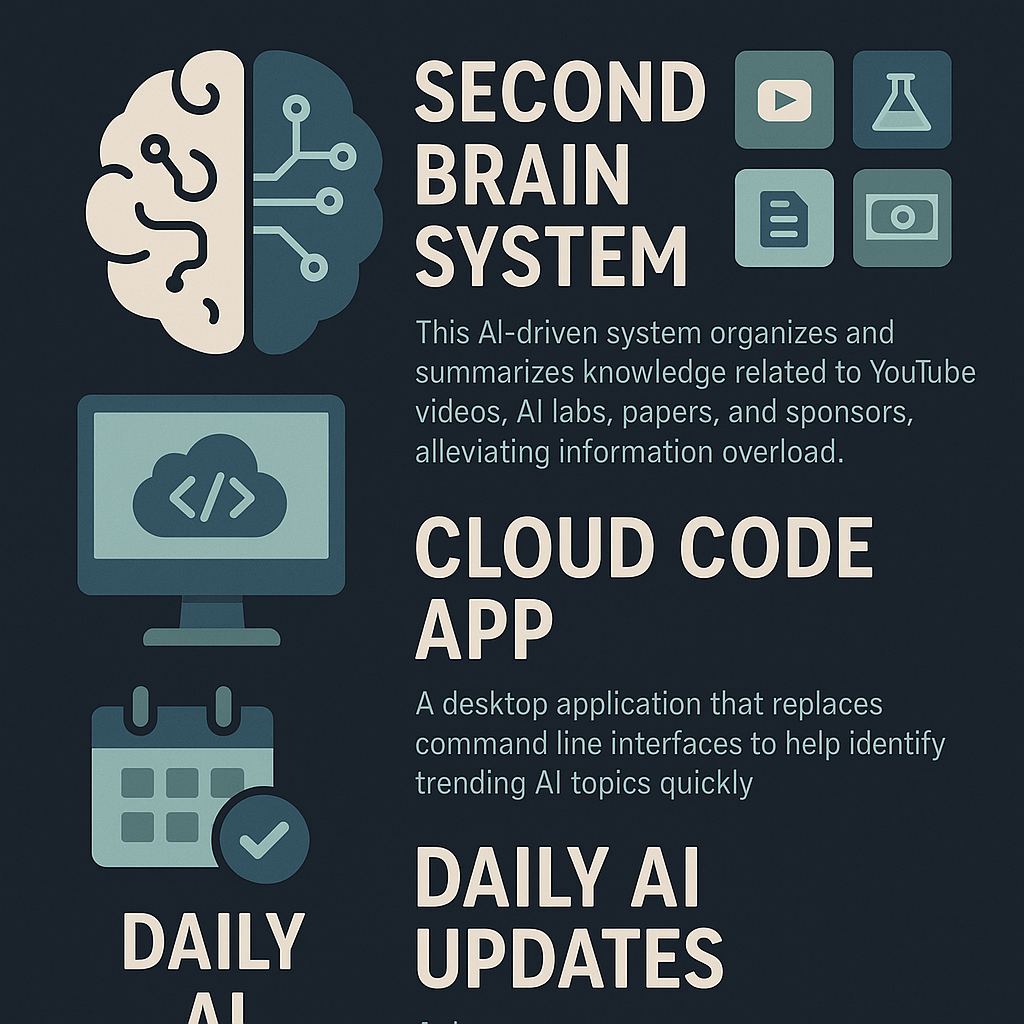
The backbone of Dupree's method is the automatic logging and summarization of information pertaining to YouTube content, AI labs, recent publications, and sponsorships. AI takes care of this monumental organizational task, ensuring that all knowledge is connected and retrievable.
2. Cloud Code App
This desktop application replaces traditional command-line interfaces for task management. Cloud Code enables users to query what's trending but not yet covered in AI, thus maintaining a competitive edge by capitalizing on unexplored topics.
3. Daily AI Updates
The AI component autonomously updates critical information daily. By managing sponsor deadlines and routine tasks, it tackles the time-intensive burdens of manual tracking, leaving creators free to focus on more strategic priorities.
4. LLM Wiki and Obsidian App
Andrej Karpathy's LLM Wiki concept forms the nucleus, focusing on efficient note organization. Obsidian, a local-first app, stores notes using markdown files, thereby mitigating data loss risks and providing a robust visualization tool via its graph view.
5. Data Parsing by AI
With AI parsing raw data to deliver instant answers, users can swiftly pull actionable insights, solving the age-old problem of slow, manual data retrieval.
6. Interconnected Library of Knowledge
The system culminates in a dynamically interconnected library where data interrelations are not merely surfaced but harnessed for actionable insights, reflecting a modern-day realization of the Memex concept envisioned by Vannevar Bush.
Examples from the Source
This is my "second brain," a system that automatically logs, connects, and summarizes all the knowledge I have about YouTube videos, AI labs, the latest papers, and even my sponsors. Most of this work is done by AI, which parses the information and provides immediate answers to my questions based on all the data I have access to.
Dupree illustrates his personal use of this system by detailing how clusters of data identify associations between different YouTube creators, including an intricate node for his own work. This node acts as a beacon for connecting topics, content, and performance metrics across platforms.
Common Pitfalls
- Failing to initially set up the AI to parse and organize data effectively, leading to continued information overload.
- Over-reliance on Cloud Code without leveraging its querying capabilities for untapped topics results in missed opportunities.
- Ignoring the local-first approach of Obsidian and losing important data with cloud-based alternatives.
- Disregarding regular updates for task management, thereby missing critical deadlines and opportunities.
- Assuming all data relationships are beneficial without analyzing their contextual relevance can lead to misinformation.
Action Checklist
- Set up a second brain system to automate data logging and summarization.
- Switch to the Cloud Code app for seamless task management transitions.
- Implement daily AI updates to stay current with all tasks and deadlines.
- Organize notes using Obsidian and explore its graph visualization feature.
- Utilize the GTD framework to manage cognitive load effectively.
- Feed raw data into the AI for swift and precise data parsing and querying.
- Create an interconnected library of knowledge for seamless information retrieval.
- Regularly review data connections and adjust strategies based on insights drawn.
Watch the Full Video
Want more like this?
The full archive of strategy + AI articles lives at strategythread.app, curated weekly, no fluff.