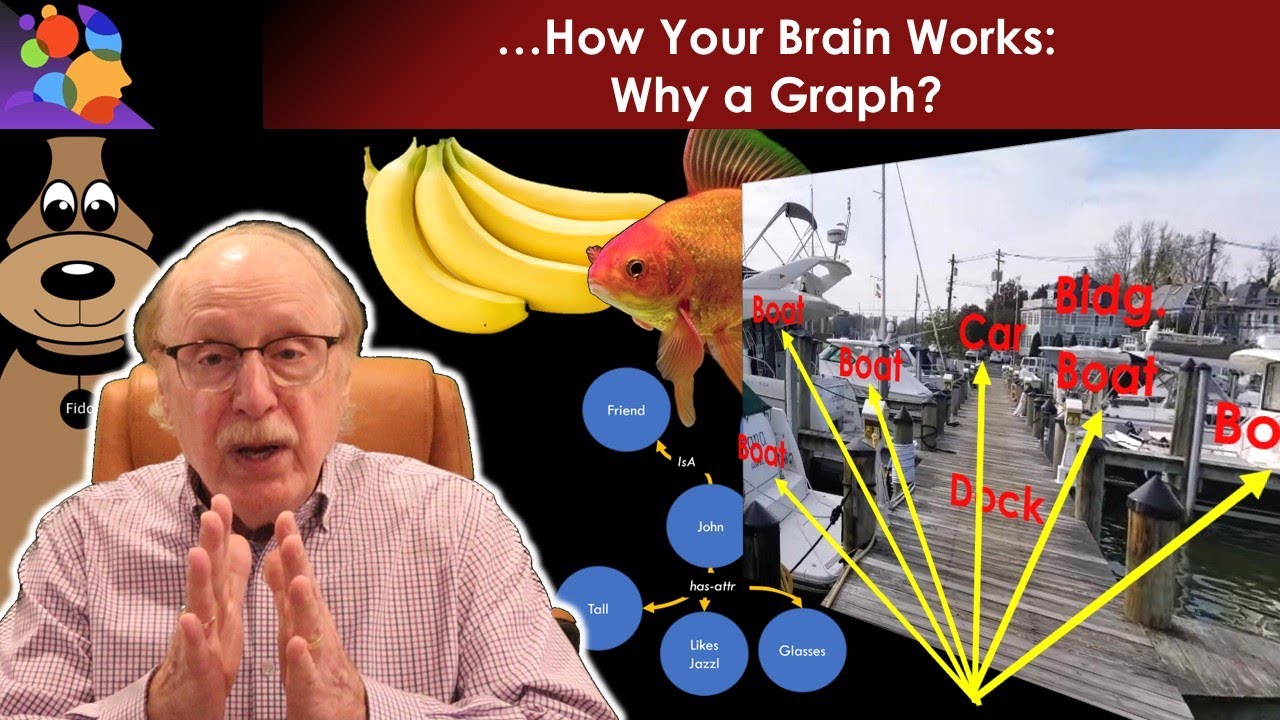
Valuable Insights from "From Dogs to Consciousness: Why Everything is in a Graph"
The video presents an intriguing exploration of the human brain's similarities to graph theory, proposing that our cognitive processes can be better understood through this mathematical framework. Here are the key insights:
1. Brain Versus AI
- The human brain exhibits advantages over current AI, particularly in energy efficiency, common sense, and the capability for one-shot learning—learning from a single experience rather than requiring vast datasets.
2. Graph Structure
- The brain operates like a mathematical graph:
- Nodes represent clusters of neurons.
- Edges symbolize the synapses that connect these clusters.
- This structure is essential for facilitating complex thinking, reasoning, and understanding.
3. Reverse Relationships & Inheritance
- The graph framework enables reverse relationships. Knowing properties of a parent node allows for deriving attributes of child nodes.
- Efficient data representation and compression are achieved through this concept of inheritance with exceptions.
4. Learning Efficiency
- The brain’s graph architecture enables quick learning from single instances, contrasting sharply with AI's dependency on extensive data training.
5. Dynamic Agents
- The agents within the brain continuously modify and maintain the graph, creating new nodes and enhancing shared properties, which contribute to its adaptability and efficiency.
6. Limitations of Current AI
- Popular AI methods like gradient descent and transformer models face limitations when attempting to replicate brain-like processes, primarily due to differences in speed and operational mechanisms.
7. Mental Models & Imagination
- The graph structure fosters the development of mental models that simulate the environment, aiding in imagination and understanding by allowing predictions of potential outcomes.
8. Understanding Consciousness
- Consciousness is proposed to be centered around a mental model that includes self-referencing, which mandates bidirectional reasoning and an understanding of context—attributes fundamentally supported by the graph model.
9. Implications for AI Development
- The conclusion emphasizes the brain’s graph model as a promising architecture for future AI systems, suggesting that systems like the Brain Simulator project can leverage these insights to create more advanced and human-like intelligence.
Final Thoughts
The video encourages a paradigm shift in how we conceive of both human cognition and artificial intelligence, proposing that adopting a graph-based approach may provide a more natural and effective pathway for replicating human-like intelligence in machines. This insight could drive innovative developments in AI that go beyond current limitations, opening new avenues for understanding consciousness and cognitive processes.
To dive deeper into the concepts discussed in the video, check it out here:
Follow along to join our learning journey and stay connected with the latest insights! Connect with me on social media: