
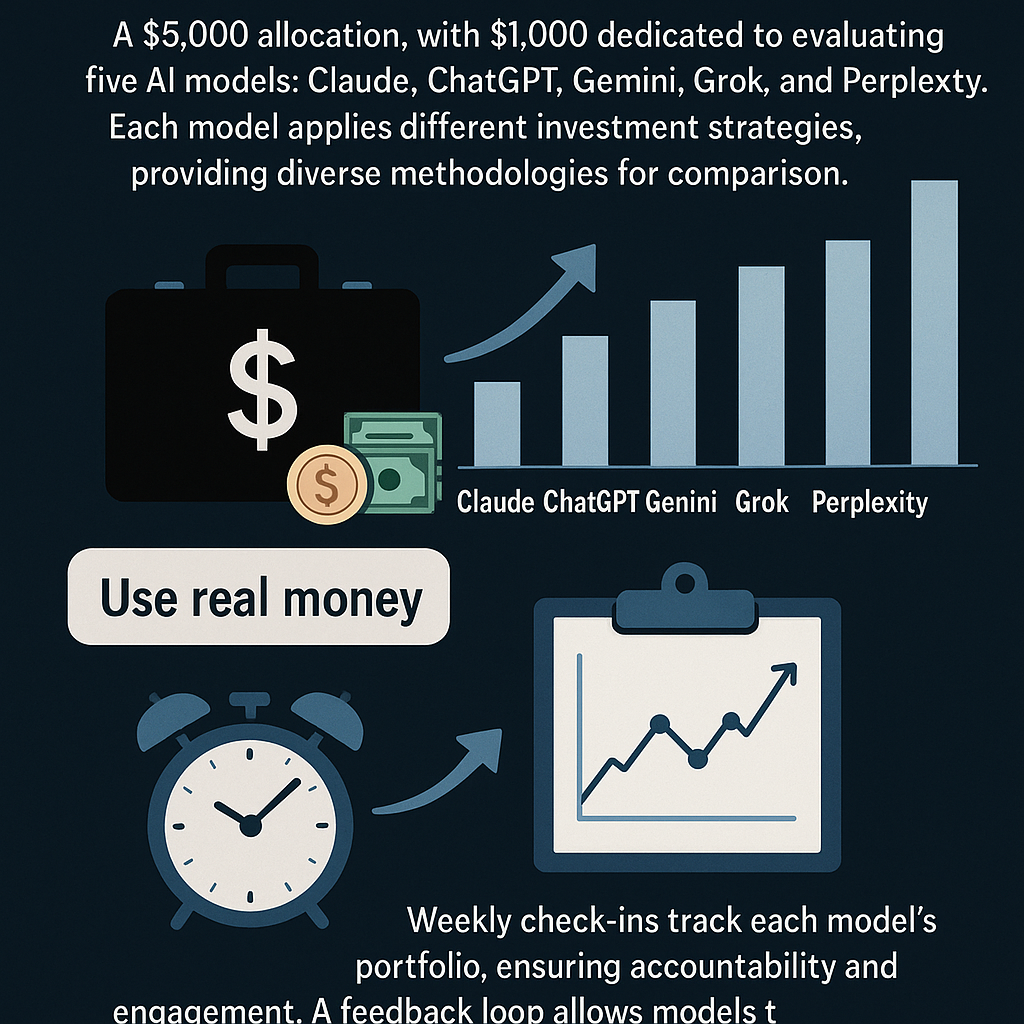
Can AI really manage investments better than humans? In an innovative experiment, Chris Koerner on The Koerner Office Podcast tests this question by investing real money into the hands of five different AI models, challenging them to outperform one another, and risking cancellation of subscriptions for the losers. This article delves into his strategy, the learnings discovered during the process, and how it can inform your approach to AI-assisted investing.
TL;DR
Chris Koerner on The Koerner Office Podcast conducted a six-month investment experiment with five AI models, Claude, ChatGPT, Gemini, Grock, and Perplexity, allocating $5,000 for comparative performance assessment. Weekly check-ins and a competitive structure helped to drive performance and insights, ultimately revealing actionable investment strategies based on AI analyses.
The Problem
Investors often face a dilemma: how to utilize artificial intelligence in their investment strategies without compromising decision quality or succumbing to the caution typically inherent in AI recommendations. Isaiah aimed to tackle this issue by involving AIs with real financial stakes, compelling them to provide actionable insights and improving accountability among the models.
The Strategy
This strategy revolves around a hands-on investment experiment using multiple AI models to evaluate diverse investment decision-making methodologies. By structuring the experiment with clear financial baselines, competitive incentives, and dynamic feedback loops, Dupree created an environment designed to yield valuable insights into the potential of AI in investing.
How It Works (Step by Step)
1. Investment Experiment Setup
Isaiah invested a total of $5,000 across five AI models, allocating $1,000 to each. This substantial commitment ensures that the AIs take their recommendations seriously and affirms the real stakes involved in their performance.
2. AI Model Selection
The five AI models chosen for the experiment were Claude, ChatGPT, Gemini, Grock, and Perplexity. Each model employs unique methodologies for making investment decisions, offering a rich comparative analysis of different AI approaches.
3. Prompt Clarity
Isaiah realized the importance of clear prompts, emphasizing to the AIs that they were providing advice based on real money. This clarity helped overcome initial hesitations from some models, leading to more actionable input.
4. Weekly Check-ins
Every Saturday, Isaiah conducts weekly check-ins where he takes screenshots of each model's portfolio holdings. This regular engagement maintains accountability and allows for ongoing analysis of their performance.
5. Dynamic Feedback Loop
By feeding back data on their portfolios, Isaiah enables the models to assess their positions against one another, which encourages them to refine their buy and sell guidance based on continuous market feedback and competitive pressure.
6. Use of Brokerage Account
Isaiah manages the investments through a Charles Schwab brokerage account, providing a secure platform for real-time investment monitoring and management.
7. Performance Reporting
The models analyze their comparative investment positions weekly, offering insights based on each other's performance. This competitive structure leads to better decision-making by factoring in peer benchmarking.
8. Risk Acceptance
Isaiah made it clear that he accepted the risks tied to the investment advice provided by the models, encouraging them to give bolder recommendations rather than retreating to caution.
9. Incentive Structure
With the understanding that underperforming models risk subscription cancellation, each AI is motivated to enhance their performance, as this serves as both a challenge and a safety net for investment advice quality.
10. Social Media Insights
Grock was chosen for its social media analytics abilities, based on the hypothesis that increased stock performance might correlate with social media mentions and public sentiment.
11. Data-Driven Decision Making
Perplexity integrates outputs from the other models to inform its investment choices, attempting to gather a collective pool of insights for enhanced strategy development.
12. Adjustable Cash Holdings
Sometimes, the AIs recommend holding cash to capitalize on future market opportunities. This strategic flexibility allows them to adapt their approaches based on market conditions.
Examples from the Source
Isaiah states:
"Claude has already more than doubled my money, which is pretty impressive."
Throughout the six-month experiment, Claude stands out as the top performer among the five models. Isaiah began the experiment with five models, managing a total investment of $5,000, at $1,000 per model, to ensure serious commitment. Each AI has its own approach, with Perplexity using output from other models for its investment guidance, while Grock draws from social media analytics. Isaiah also notes:
"After setting up the accounts, I faced some challenges in prompting them to provide tangible investment advice instead of theoretical suggestions."
Weekly check-ins are integral to this process. Isaiah conducts these every Saturday, taking screenshots that allow for competitive evaluation among the models, creating an environment ripe for accountability and performance improvement. The use of a Charles Schwab brokerage account provides real-time investment tracking, reinforcing the real stakes involved.
Common Pitfalls
While Isaiah's experiment offers valuable insights, there are common pitfalls to avoid when working with AI in investments:
- Vagueness in Prompts: Not providing clear and specific prompts can lead to non-actionable or overly cautious responses from AI models.
- Neglecting Accountability: Failing to conduct regular performance reviews can reduce motivation among AIs, leading to stagnant or ineffective advice.
- Ignoring Risks: Underestimating or not being clear about the acceptance of risks can hinder AI models from delivering bold recommendations.
- Choosing the Wrong AI Models: Using AI models with similar methodologies without diversity might limit the insights gained from comparative performance.
- Static Strategies: Holding cash or failing to adapt strategies based on market shifts can result in missed opportunities.
Action Checklist
- Define clear and actionable investment prompts for each AI model involved.
- Invest a meaningful amount to ensure real stakes are at play in performance assessments.
- Conduct weekly check-ins to maintain engagement and accountability with the AI models.
- Encourage competitive dynamics by establishing consequences for underperformance.
- Incorporate a brokerage platform that allows for real-time tracking of investments.
- Fully communicate the risks involved to enable models to provide bolder recommendations.
- Utilize diverse AI models to gain varied perspectives and strategies.
- Continuously adapt investment strategies based on both market changes and model performance.
Watch the Full Video
If you want to see the full context and details of this experimentation and the insights gained, watch the full video here.
Want more like this?
The full archive of strategy + AI articles lives at strategythread.app, curated weekly, no fluff.