
Ever thought about a business that runs itself, allowing you to focus on other opportunities while still generating income? Luke Vander's model of renting out lead generation websites presents a roadmap to financial independence for anyone willing to put in the foundational work. With his methods, you can stop worrying about client calls at inconvenient times or the consistent grind of traditional agency work. Let’s explore how he does it.
TL;DR
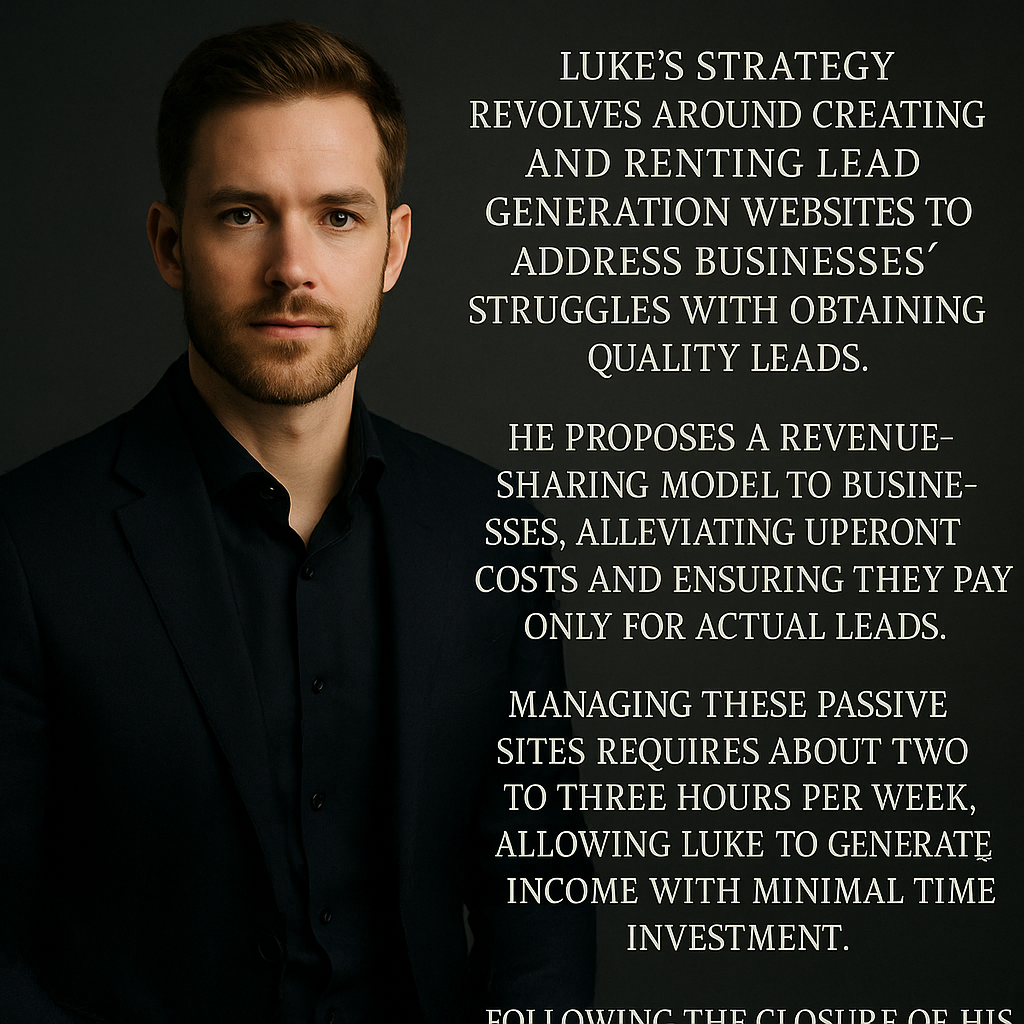
Luke Vander’s business model focuses on creating and renting out lead generation websites, allowing for passive income with minimal time investment, about two to three hours a week. By forming revenue-sharing deals with local businesses and specializing in targeted markets, he addresses common pain points for both himself and the companies he partners with.
The Problem
Many businesses struggle with generating consistent and quality leads. This difficulty often leads to dependency on unreliable marketing strategies, causing stress and financial uncertainty. Entrepreneurs like Luke found typical agency work to be stressful and time-consuming, bogged down by client demands, leading to burnout and a feeling of being trapped in a job rather than running a business. The financial pressure of traditional client work also becomes untenable, forcing business owners to seek alternatives to generate sustainable income without the client dependency.
The Strategy
Luke's strategy revolves around building and managing lead generation websites in specific niches, essentially creating an asset that serves multiple businesses. By forming revenue-sharing partnerships, he allows businesses to minimize upfront costs while ensuring they only pay for genuine leads. This model is significant for both sides, as it reduces risk for businesses and allows Luke to maintain full control over his income, and his time. The shift from being an agency owner to owning lead generation assets represents a crucial transition toward vertical integration, emphasizing self-sufficiency over client dependency.
How It Works (Step by Step)
Step 1: Choose Your Niche
Select a niche that has high demand and low competition. Luke chose multiple niches including towing, HVAC, limos, electrical services, and tree services.
Step 2: Identify Your Market
Luke strategically targeted Woodside, Queens, with a population of around 60,000 residents for his towing site. Choose a locality with potential demand to ensure viable business opportunities.
Step 3: Build Your Lead Generation Website
Create a website optimized for generating leads. Make sure the site is relevant to your selected niche and appealing to local businesses that might want to rent it.
Step 4: Focus on SEO
Invest 2 to 3 months on ranking your websites effectively. Good SEO practices ensure that your websites will attract visitors, which translates to leads for the businesses you partner with.
Step 5: Reach Out to Businesses
Contact local businesses with a proposal for a revenue-sharing arrangement. Many businesses will find this option appealing as they pay only for leads generated, minimizing their risk.
Step 6: Manage and Monitor
Dedicate two to three hours each week managing your sites. Not every site will require equal attention; focus on those that yield higher revenue.
Step 7: Scale the Model
Once you establish a routine with a couple of sites, consider adding more niches and expanding into new markets to further diversify your income streams.
Examples from the Source
“I initially had an HR job which I didn’t enjoy. I explored various side hustles, like selling on eBay and Amazon, drop shipping, and affiliate marketing. I even learned Facebook ads and attempted to create a Facebook agency, which did bring in some money.” - Luke Vander
“I accepted an immediate income drop of $108,000 by letting go of most clients, relying instead on my ability to generate leads for myself.” - Luke Vander
“I’m making around four or five grand from one passive site, which is great, but if I could make 30 or 40K off it, that would be more worthwhile.” - Luke Vander
“I have three acquaintances who’ve made over a million dollars since 2022 with this side hustle.” - Luke Vander
“Woodside has around 60,000 residents, and I chose it because it seemed like a good market for towing services.” - Luke Vander
Common Pitfalls
Many people may misstep on their journey into lead generation websites. Here are a few pitfalls to avoid:
- Neglecting SEO: Not investing enough time to rank websites will result in fewer leads, nullifying the purpose of the effort.
- Choosing Saturated Markets: Selecting a niche with high competition can lead to frustration and financial loss.
- Forgetting About Monitoring: Even a passive income model needs oversight. Failing to monitor performance can lead to missed opportunities.
- Ignoring Revenue Sharing Agreements: Not clearly outlining payment structures or communication channels can result in misunderstandings.
- Being Overly Committed to Client Work: Holding on to too many clients while trying this model can lead to burnout. Remember, the goal is to establish passive income.
Action Checklist
- Research viable niches and target markets.
- Build and launch your first lead generation website.
- Implement effective SEO strategies for visibility.
- Contact local businesses to discuss revenue-sharing agreements.
- Track your time investment and ensure it remains minimal while maximizing income.
- Diversify your portfolio with sites in different niches as you grow.
- Network with other lead generation professionals for tips and partnership opportunities.
- Regularly reevaluate your performance and make adjustments as necessary.
Watch the Full Video
For an in-depth look at Luke Vander's model, watch the full video here.
Want more like this?
The full archive of strategy + AI articles lives at strategythread.app, curated weekly, no fluff.