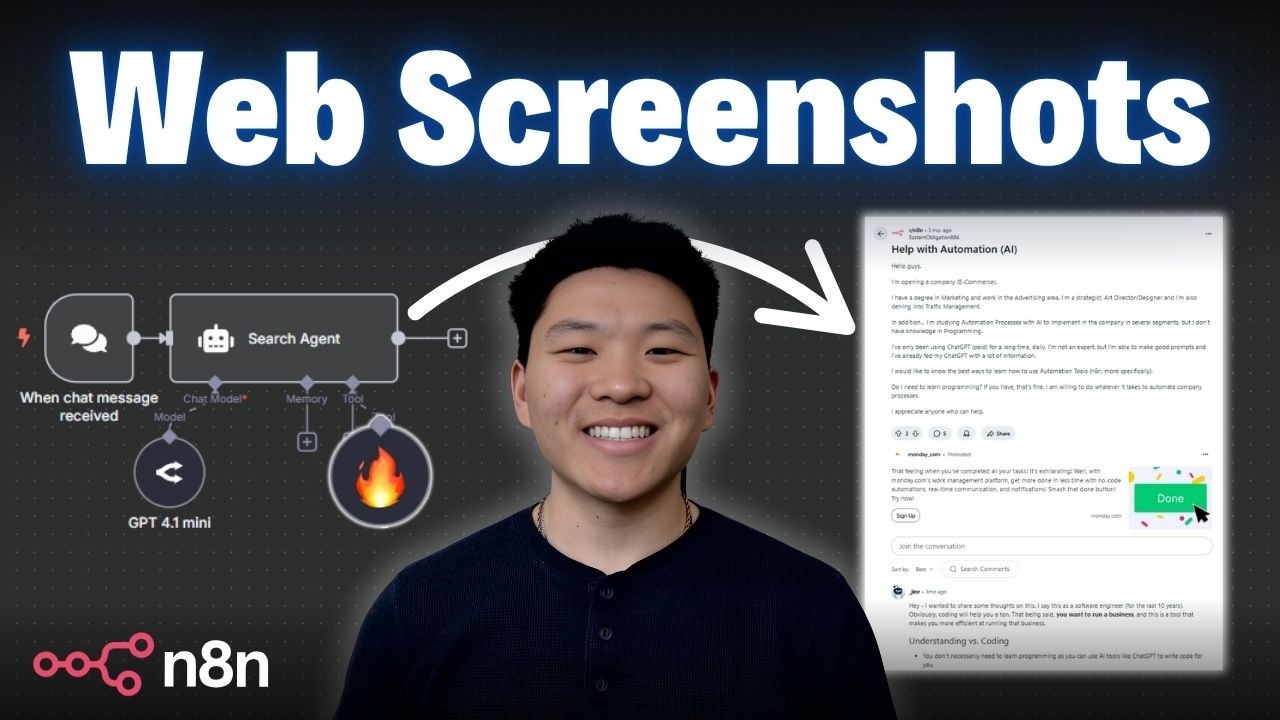
Unlocking AI Potential: Insights from Nate Herk's Tutorial

In a groundbreaking video, Nate Herk introduces an AI agent that can scrape web content and provide screenshots without requiring any coding expertise. The following insights distill the key themes and practical applications discussed in the tutorial, empowering users to leverage this powerful tool.
Valuable Insights from the Video Transcript
Key Points:
- AI Agent Functionality: The AI agent can perform web searches using a single API call, providing customized search results based on user queries. It retrieves articles and content in a structured format (Markdown) and includes screenshots of the pages.
- NLP Interaction: Users can interact with the AI using natural language, simplifying the process of obtaining specific information.
- Demonstration of Features: In a demo, the agent found articles on Reddit incorporating specified keywords in their titles, complete with corresponding URLs and screenshots to ensure authenticity.
- Customization and Control: The search API allows users to filter results by various criteria, enabling highly customized searches.
- Ease of Setup: No coding skills are required to set up the AI agent, thanks to guided templates that simplify the configuration process.
Insights:
- Power of Automation: Utilizing AI for automated searches can enhance efficiency in gathering information, especially for research and professional projects.
- User Accessibility: The agent's user-friendly design eliminates technical barriers, empowering everyone to access advanced search capabilities.
- Practical Applications: This technology is versatile and applicable in fields such as digital marketing, research, and personal information gathering.
Actionable Advice:
- Getting Started: Join Nate's community to access setup templates, making the learning process easier.
- Experiment with Query Operators: Try different query operators in searches to further refine results.
- Utilize Screenshot Features: Leverage the screenshot feature to visually verify content quality.
- Consider Broader Potential: Explore how the AI's capabilities can streamline other tasks or workflows.
Supporting Details:
- The video includes specific search queries and results, demonstrating the AI's potential in real time.
- Resources like API documentation and community support are invaluable for users during setup and experimentation.
Personal Reflections:
The integration of AI in searching and data scraping is a game-changer, enhancing productivity significantly. The interface's simplicity and natural language capabilities invite non-technical users to explore AI tools, bridging the gap in technology adoption. This innovative technology aligns with current trends toward automation and opens the door to more sophisticated tools in the future.
Conclusion:
The video by Nate Herk reveals how an AI agent can dramatically simplify web searches, making it a vital resource for users eager to harness the power of AI in their daily tasks.
For more insights and to continue your learning journey, follow my social media channels:
- TikTok: https://www.tiktok.com/@isaiah_dupree
- Instagram: https://www.instagram.com/the_isaiah_dupree
- YouTube: https://www.youtube.com/channel/UCnDBsEL2jOaEiSyxA77tNNA
- Email: isaiahdupree@techmestuff.com
- Discord: https://discord.com/users/692484921826082868
- Twitter: https://twitter.com/isaiahdupree7
- Facebook: https://www.facebook.com/profile.php?id=81562079181208
- Snapchat: https://www.snapchat.com/add/yourbeautifulvv
- Pinterest: https://www.pinterest.com/isaiahdupree33/
- TechMeStuff: https://techmestuff.com
Watch Nate Herk's full tutorial for a more in-depth understanding: