Disclosure: This article was generated with AI and reviewed against the source transcript.
A customer builds something useful in your product. They can explain what they made, show the result, and help someone else reproduce it. That moment gives a marketing team three concrete assets: a lesson, a demonstration, and a customer perspective.
It also gives the team a better starting point than a calendar full of unrelated post ideas.
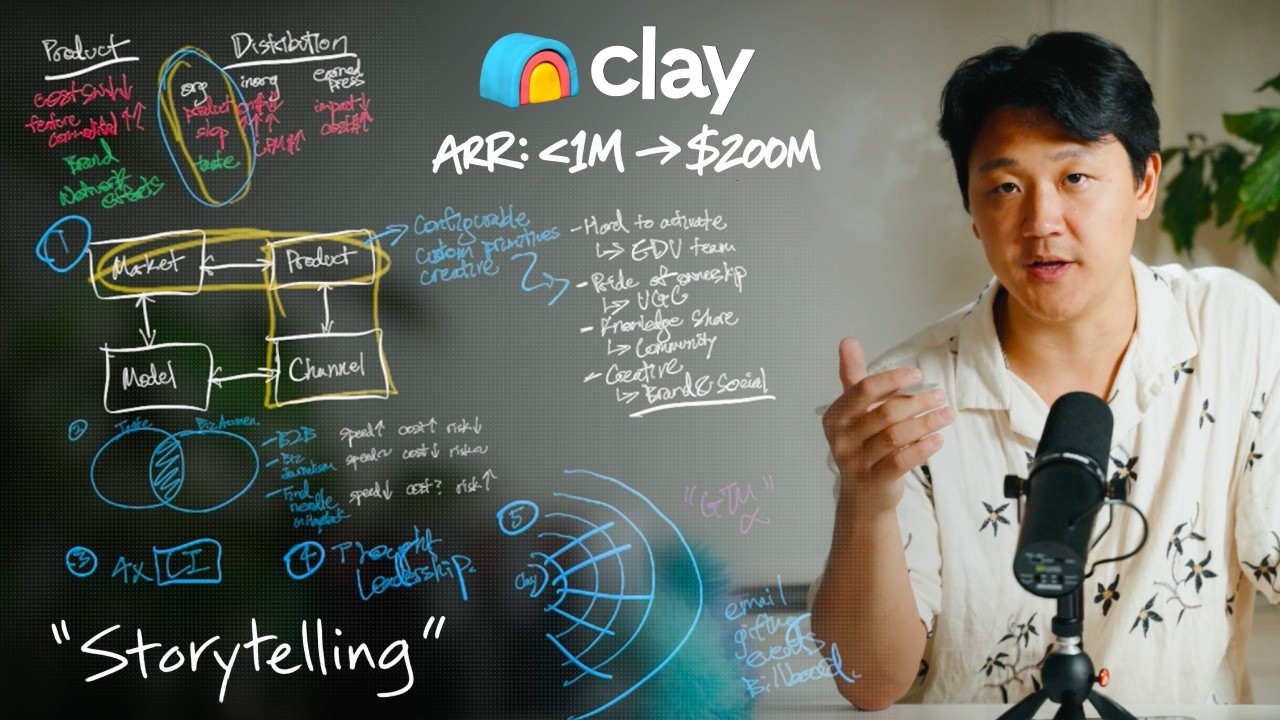
In his video “This is how we dominated the market”, Peter Kang describes his experience leading social at Clay. His account connects the product’s flexibility with the company’s investments in education, community, creative staff, and a recognizable way of discussing go-to-market work.
The useful lesson is a design question: what kind of content helps people become capable users of the product, and what becomes possible once they are?
Start with a customer’s first useful result
Kang describes Clay as a product that gives users configurable building blocks. That flexibility creates room for individual solutions, while also making the product harder to learn than a tool with a single obvious action.
According to his account, education was a response to that difficulty. He points to Clay University, cohorts, and educational material as investments intended to help people learn and activate.
For a founder, this suggests a practical way to choose an editorial subject. Identify one useful result a new customer wants. Write down the decisions and actions between opening the product and achieving that result. Look for the point where the customer has to make an unfamiliar decision.
That point is a candidate for a lesson.
For example, a hypothetical workflow builder might give a customer several ways to route an incoming request. A useful article could explain how to choose a routing rule, demonstrate the resulting workflow, and show how to check whether a request reached the right destination. The example would teach a complete task, with enough detail for a reader to attempt it.
This is an application of Kang’s account, rather than a claim about a measured result from our own product. Its value would have to be checked with actual customers.
Make finished customer work easy to understand
Learning a flexible product can produce something worth showing. Kang describes users taking pride in what they build, sharing use cases, and exchanging knowledge. In his account, Clay’s social work repeatedly brought attention to those users and their creations.
That makes the customer’s work part of the editorial material. A demonstration can explain a capability more clearly than a broad list of features because the reader can see the input, the choices, and the finished result together.
The editorial job is to make that example legible. Explain the problem the customer faced. Show the relevant part of what they built. Describe the constraints that affected the solution. Give the reader a sensible way to adapt the idea to a different situation.
Customer permission and clear attribution matter here. A public example should retain the customer’s role in creating it and avoid implying that one person’s outcome is typical. If the team cannot substantiate an outcome, it can still describe the workflow without attaching an unsupported performance claim.
A collection of concrete examples also gives a community something useful to discuss. Members can compare approaches, suggest improvements, and explain the tradeoffs they encountered. The material becomes more useful when the people doing the work can contribute their perspective.
Give a substantial article a real reporting process
Kang also describes longer pieces about GTM alpha and the GTM engineer. He says this work involved repeated discussion with founders, marketing leaders, customers, and experienced users over an extended period.
The detail that stands out is the reporting process. A substantial article had to explain how buyers understood a changing field and how the company’s own thinking related to the work those buyers were doing.
A smaller team can apply that principle at a smaller scale. Before drafting an ambitious argument, collect a few specific observations: a recurring customer question, an example of a workflow changing, and a disagreement about how to approach the problem. Ask what those observations support and where they conflict.
Then give the article one clear job. It might explain a decision buyers are struggling to make, define a useful distinction, or walk through a change in how a task is performed. Claims should be traceable to the material collected for the piece.
The resulting article needs to remain useful even to a reader who never buys the product. That is an editorial standard a team can assess directly: does the piece help the reader understand or do something specific?
Plan distribution around the idea
Kang’s account includes repeated distribution through company and executive channels, employees, creators, partners, and community members. He describes shared language appearing across multiple kinds of communication.
For a small team, the practical move is to decide what each distribution surface can contribute to the same idea. An article can explain the full argument. A short demonstration can show one example. A customer contribution can describe where the approach worked or needed adjustment. A follow-up can answer a question the original piece left open.
Each version should stand on its own. Readers need enough context to understand the point without first reconstructing an entire campaign.
Distribution also creates a chance to check the editorial premise. Record which questions people ask, which examples they discuss, and whether the material helps customers make progress. Those observations can inform the next piece. Publishing volume alone cannot establish that the explanation was useful.
Treat the case as a source of hypotheses
Kang attributes substantial growth to the broader approach he describes. This article has not independently verified those growth figures or isolated the contribution of any individual activity. His video also acknowledges other work, including events, lifecycle communication, and billboards.
The case therefore supports questions worth investigating: does the product’s learning curve create a need for education? Do users produce work that others want to understand? Does a substantial article clarify a real decision for buyers? Can existing channels carry that explanation to the people who need it?
Choose one customer task, produce one complete explanation, and attach a way to observe whether it helped. Use that evidence to decide what deserves a second installment.
Source: Peter Kang, “This is how we dominated the market”. This is an independently written summary and analysis of his account. The workflow-builder example is illustrative; company outcomes remain attributed source claims.